
Medical equipment does not measure one universal quantity called medical pressure. It measures pressure at a defined point, relative to a defined reference, and then uses that signal for control, display, alarm handling, or a higher-level calculation. That is why the best MEMS pressure sensor for a ventilator may not be the best choice for a blood-pressure cuff or a negative-pressure wound-therapy system.
This guide explains where pressure sensing fits in common medical and pneumatic equipment, how to define the measurement before selecting a component, and where Reliava's compensated RP3011G and RP3012G board-level MEMS pressure sensors may fit in an OEM design.
Engineering and qualification note: RP3011G and RP3012G are board-level components for OEM integration. They are not finished medical devices and this article does not claim medical-device certification, regulatory clearance, patient-contact suitability, or compatibility with a particular gas or cleaning process. The device manufacturer remains responsible for system validation and all applicable regulatory requirements.
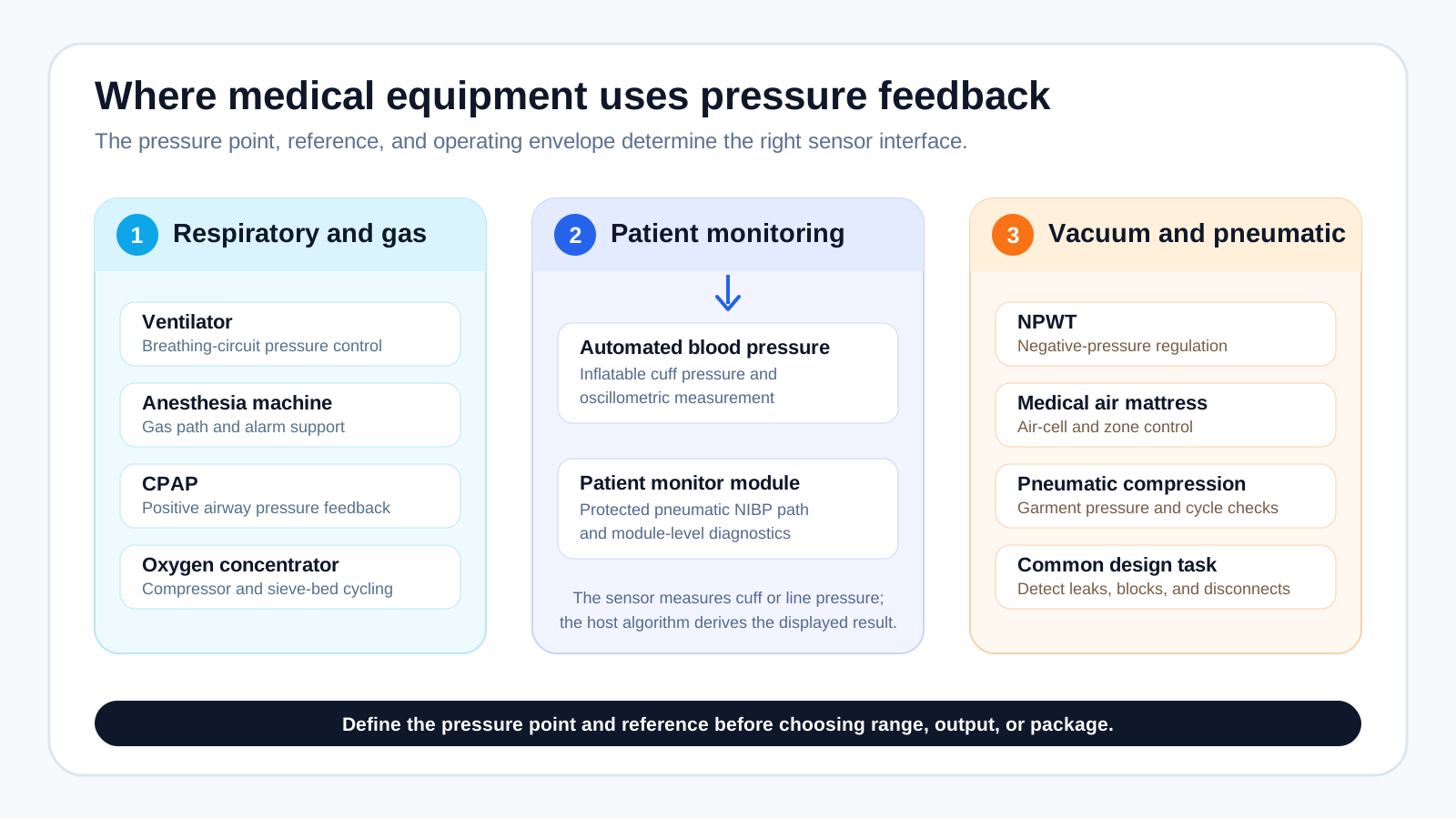
Where Pressure Sensing Fits in Medical Equipment
The same MEMS technology can support different products when the package, pressure interface, range, output, and qualification plan are matched to the application. Start by identifying the job the pressure signal must perform:
- Respiratory and gas-delivery equipment: measure airway, breathing-circuit, compressor, valve, or gas-path pressure for control and alarm decisions.
- Patient-monitoring equipment: measure the pressure in an inflatable cuff or a protected pneumatic monitoring module so an algorithm can estimate or report a patient parameter.
- Vacuum and pneumatic therapy: regulate negative pressure, air-cell pressure, or compression pressure and detect leaks, restrictions, and disconnected tubing.
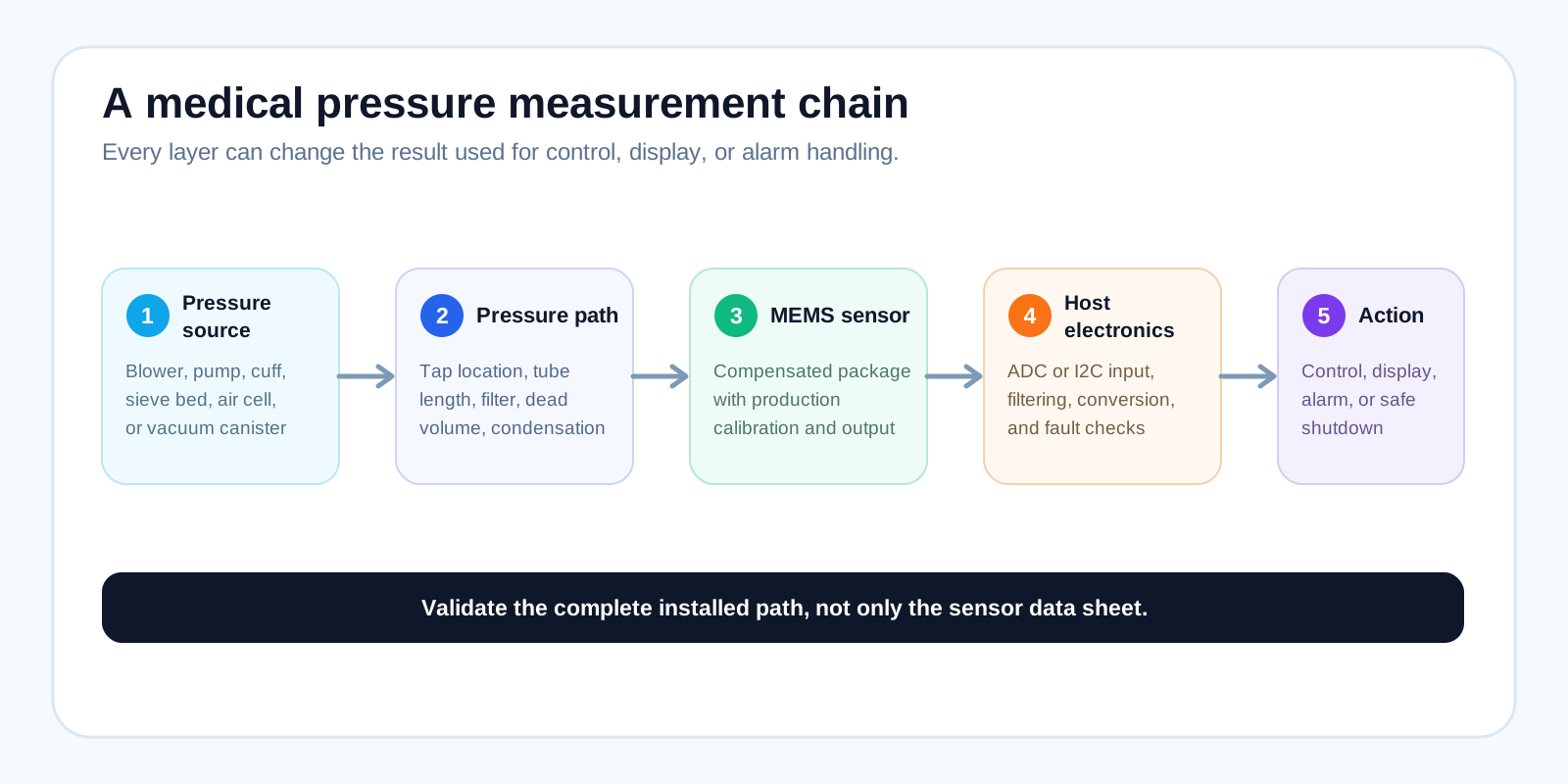
A sensor does not create the medical result by itself. The installed pressure path, host electronics, firmware, and fault logic all contribute to the final behavior.
Respiratory and Gas-Delivery Equipment
Ventilators
A ventilator may use pressure feedback in the breathing circuit, near a valve or blower, or at another defined pressure tap. The location changes what the signal means. Blower operation, valve timing, patient effort, filters, humidification, tubing resistance, and circuit leaks can all shape the measured waveform.
For an OEM ventilator design, document the pressure tap, tubing length and inner diameter, expected pressure range, startup and shutdown transients, response time, condensation risk, and the behavior that should trigger an alarm. Test the complete circuit rather than evaluating the sensor on an open bench. A sensor with a suitable range can still produce a poor system result if the pressure tap or tubing adds delay, restriction, or trapped moisture.
Anesthesia Machines
Anesthesia equipment can contain several pressure points: an internal control line, a gas-delivery path, and the breathing circuit. These points may use different pressure references and may have different media, temperature, humidity, and cleaning exposures. Define whether the design needs gauge, differential, or absolute pressure before comparing sensors.
Material and interface review is especially important when the pressure path may see oxygen-enriched gas, anesthetic vapor, condensate, or cleaning residue. Do not infer media compatibility from the word MEMS or from a pressure range. The complete pressure path, barrier, filter, seal, and cleaning process must be qualified by the device manufacturer.
CPAP and Positive Airway Pressure Systems
A CPAP system regulates positive pressure delivered through a mask or patient circuit. The control loop normally compares a measured pressure with a target and adjusts the blower or valve. Selection therefore depends on the usable pressure range, resolution, noise, response, pressure-path volume, and the way the sensor is mounted in the product.
Evaluate the sensor while the actual blower, mask circuit, filter, and tubing are operating. A quiet room-temperature sensor test does not reveal pressure ripple, tube lag, condensation, or electrical noise from the motor drive. The range should cover the normal setpoint and credible fault or startup conditions without sacrificing the resolution needed by the control algorithm.
Oxygen Concentrators
Oxygen concentrators use a compressor, valves, and sieve beds in a repeating pressure cycle. A pressure sensor can support compressor monitoring, valve sequencing, or fault detection in the pneumatic path. It measures pressure; it does not measure oxygen concentration. Oxygen purity requires a separate measurement method and its own validation.
For any oxygen-enriched path, review material selection, cleanliness, seals, filters, and the exact gas exposure with the device safety and compliance teams. This article does not establish oxygen compatibility for any Reliava component.
Pressure Measurement in Patient-Monitoring Equipment
Automated Blood Pressure Monitors
An automated blood pressure monitor measures the pressure inside an inflatable cuff. The cuff pressure is a relatively large pneumatic signal with smaller oscillations caused by arterial pulses. The monitor's algorithm uses those oscillations to estimate systolic, diastolic, and mean pressure; the sensor does not directly measure blood pressure on its own and it does not need to contact blood.
The selection target is therefore not just the largest pressure range. Check cuff inflation and deflation limits, resolution, noise, repeatability, response time, pressure reference, overpressure protection, pneumatic filters, and the complete NIBP module's fault behavior. Confirm that the sensor interface and package match the protected pneumatic design used by the finished monitor.
Patient Monitor NIBP Modules
In a patient monitor, a board-level pressure sensor may sit inside a dedicated NIBP module with tubing, valves, a pump, and electrical protection. The word patient monitor is too broad to define the required sensor by itself. Specify whether the design is a non-invasive cuff module, an invasive fluid-isolated pressure channel, or another architecture. These are different measurement chains and should not be treated as interchangeable.
RP3011G and RP3012G are gauge pressure components for board-level OEM integration. If the intended design exposes the sensor to liquid, a patient-contacting path, or a fluid-isolated transducer assembly, the device team must confirm that the package and isolation architecture are appropriate before proceeding.
Vacuum and Pneumatic Therapy Systems
Negative-Pressure Wound Therapy (NPWT)
NPWT equipment regulates a vacuum path connected to a dressing and canister. A pressure sensor may be placed near the pump, canister, or dressing interface. Each location gives a different view of the system: a pump-side sensor can miss a restriction near the dressing, while a dressing-side sensor can be more sensitive to leaks, filters, and tubing changes.
Define the normal negative-pressure envelope, pump ripple, blocked-line condition, disconnected-line condition, leak rate, filter behavior, and condensation risk. Then test the complete tubing, canister, filter, and dressing configuration. The sensor range must cover negative pressure and credible transients while leaving enough signal detail for the leak and obstruction logic.
Medical Air Mattresses
Air mattresses typically use a pump, manifold, and multiple air cells or zones. The pressure dynamics are slower than a ventilator, but leaks, patient movement, valve state, and cell-to-cell variation can dominate the measurement. A sensor may be used for zone inflation control, leak detection, or a time-based plausibility check.
Pneumatic Massage and Compression Equipment
Pneumatic massage or compression equipment can use pressure feedback to control an inflatable chamber or garment. The design must account for garment fit, body load, tubing leaks, pump cycling, and the difference between a wellness product and a regulated compression device. Pressure feedback is only one part of the finished product's safety and performance validation.
Where RP3011G and RP3012G Fit
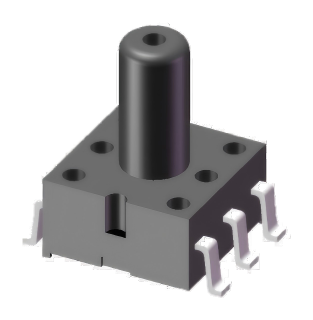
The RP301x family is intended for compact OEM designs that need a compensated, production-calibrated gauge MEMS pressure sensor on a PCB. The product integrates a signal-conditioning IC; it is not an unconditioned die that the OEM must calibrate from scratch. The host product still needs to validate the complete pressure path, mounting, temperature behavior, firmware conversion, EMC, and application-level fault handling.
- RP3011G: analog-output variant for an OEM ADC or analog control input. Confirm the exact output transfer function and order code; the product family listing includes 0.5-4.5 V and other variants.
- RP3012G: I2C digital-output variant for a host that can read and validate a digital pressure value. Confirm address, timing, supply, and diagnostic behavior from the current datasheet.
- Pressure ranges: the gauge family includes bidirectional -10 to +10 kPa, -40 to +40 kPa, and -100 to +100 kPa options. Select the narrowest range that covers the complete normal and fault envelope; a wider range adds headroom but may reduce usable pressure detail for a low-pressure control loop.
- Supply and package: the current product listing identifies a 2.7-5.5 V supply range and SOP6 package. Verify the exact order code, pinout, output, pressure port, and latest datasheet before design freeze.
For the analog-versus-digital interface decision, see the Analog vs I2C MEMS Pressure Sensors guide. For pressure reference and range terminology, use the gauge, absolute, and differential pressure guide before selecting a part number.
Five Questions to Answer Before Selecting a Medical Pressure Sensor
- What is the pressure reference? Is the measurement gauge, differential, or absolute? State the reference side and the common-mode pressure. A correct numeric range with the wrong reference is still the wrong sensor.
- What is the complete pressure envelope? List normal operation, startup, shutdown, pump ripple, blocked or disconnected tubing, reverse pressure, and any credible fault. Compare this envelope with the calibrated range, proof pressure, and burst or overload limits separately.
- What is the smallest useful pressure change? Convert the application requirement into Pa, kPa, or mmHg. Compare accuracy, total error, repeatability, hysteresis, noise, temperature drift, ADC resolution, and software filtering rather than relying on one headline percentage.
- What can reach the pressure port? Review humidity, condensation, cleaning residue, oil, anesthetic vapor, oxygen enrichment, particles, and liquid exposure. Decide whether a filter, barrier, trap, or remote pressure port is needed, and qualify the complete interface.
- How should the system fail? Define the response to a blocked or disconnected tube, sensor supply interruption, invalid digital data, out-of-range analog voltage, pump failure, and implausible pressure. Separate pressure faults from electrical and pneumatic faults so the host can make a safe decision.
Integration Details That Often Decide the Result
A compensated sensor can still miss the system target if integration details are ignored. Pressure tap geometry and tubing volume affect response time. Filters can protect the port but add restriction and delay. PCB bending, mounting screws, enclosure stress, connector tolerances, and thermal gradients can shift the installed output. Firmware filtering can reduce noise, but excessive filtering can hide a fast alarm condition.
Repeat the pressure, temperature, vibration, leak, and EMC checks on the final assembly, with the final tubing, valves, filters, housing, and firmware. A component datasheet is an input to device qualification; it is not a substitute for validation of the finished medical equipment.
Common Selection Mistakes
- Choosing by application name alone: ventilator, NIBP, or NPWT does not define the pressure point, reference, range, media, or output by itself.
- Sizing only for normal pressure: startup, blocked-line, pump, and disconnected-line events may need more range or a separate protection strategy.
- Confusing pressure with gas concentration: a pressure sensor cannot replace an oxygen-concentration measurement method.
- Assuming compensation equals device qualification: sensor-level compensation and production calibration do not qualify the PCB, tubing, enclosure, firmware, alarm logic, or medical-device use case.
- Filtering away the event you need to detect: balance noise reduction with the response time required for control and alarm decisions.
Frequently Asked Questions
What is a MEMS pressure sensor for medical applications?
It is a compact pressure-sensing component integrated into equipment such as a ventilator, CPAP system, NIBP monitor, oxygen concentrator, NPWT pump, or pneumatic therapy device. The application determines the required pressure reference, range, pressure path, output, materials, and validation plan; the phrase medical application does not define those parameters by itself.
Can one sensor be used for CPAP and NPWT?
Possibly, but not automatically. CPAP is a positive-pressure application and NPWT is a negative-pressure application. The sensor must cover the correct bidirectional envelope, use the right pressure reference, tolerate the actual medium and contamination risk, and provide enough resolution and response for each control or fault function. The installed pressure path and qualification requirements may still be different.
Does a blood pressure monitor sensor contact blood?
No, not in a conventional non-invasive cuff monitor. The sensor measures air pressure inside the cuff, while the monitor algorithm uses cuff-pressure oscillations to estimate blood-pressure values. Invasive fluid pressure systems use a different architecture and require fluid isolation and application-specific qualification.
Can a pressure sensor measure oxygen concentration?
No. Pressure and oxygen concentration are different measurements. A pressure sensor can monitor the compressor, valve, sieve-bed, or delivery pressure in an oxygen concentrator, but oxygen purity requires a separate sensing method and validation.
What is the difference between RP3011G and RP3012G?
They are board-level gauge MEMS pressure sensor variants in the RP301x family. RP3011G is used when the host wants an analog voltage output; RP3012G is used when the host wants an I2C digital interface. Both are compensated and production-calibrated at the sensor level. Confirm the exact output transfer function, range, supply, pinout, and current qualification documents for the selected order code.
Conclusion: Start With the Measurement, Then the Part Number
The right MEMS pressure sensor for medical equipment is selected from the complete measurement chain, not from the application label alone. Define the pressure point, reference, normal and fault envelope, smallest useful change, medium, interface, and safety response first. Then compare range, accuracy, output, supply, package, pressure protection, and qualification evidence.
Reliava's RP3011G analog and RP3012G I2C variants can be evaluated when a compact, compensated, production-calibrated board-level gauge sensor fits the OEM architecture. Send us the equipment type, pressure profile, reference, medium, output, supply, installation drawing, expected volume, and qualification target so we can recommend the appropriate variant and range.