
The Short Answer
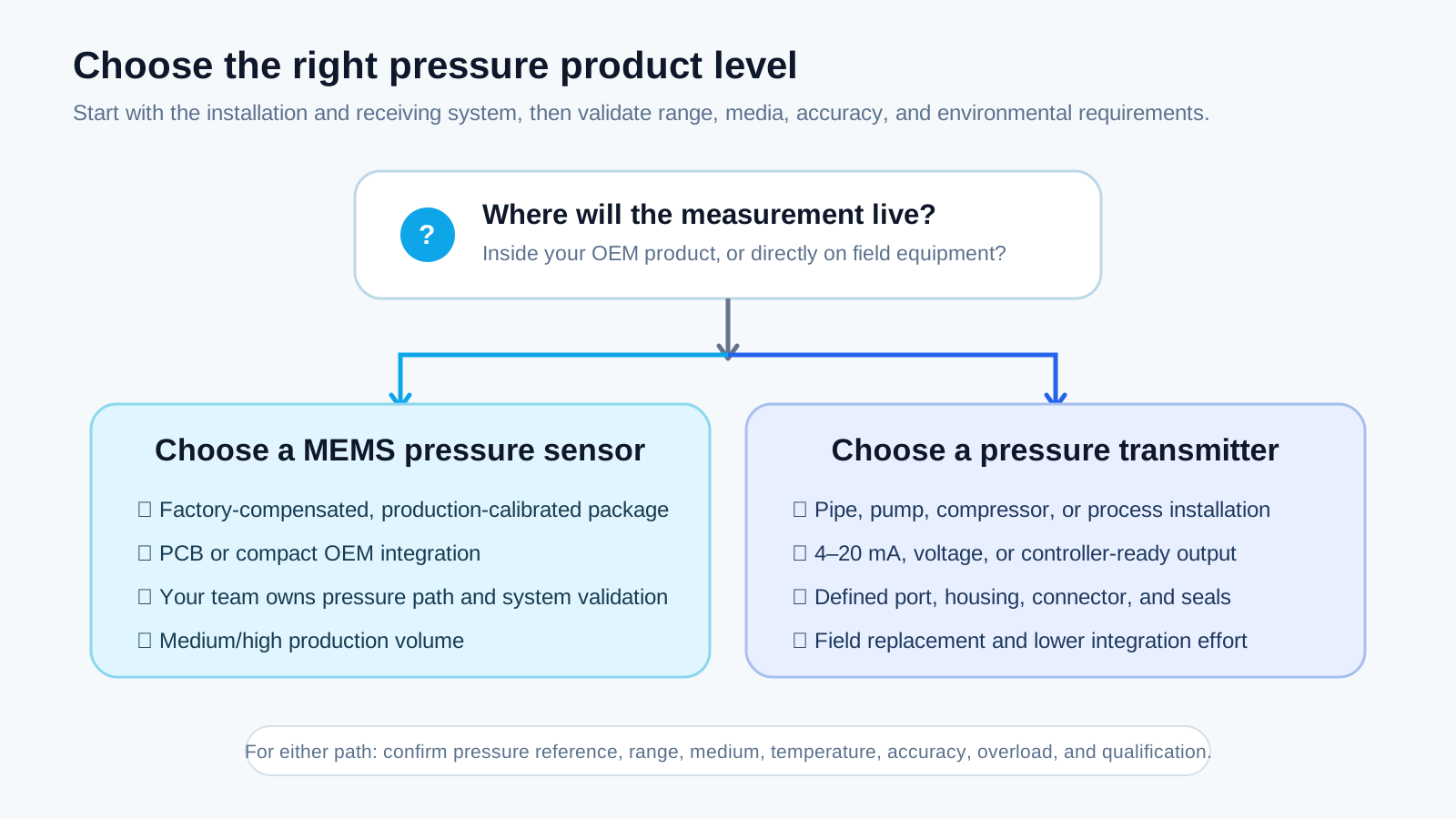
Choose a board-level MEMS pressure sensor when you need a compact, factory-compensated and production-calibrated device for OEM integration, and your product team owns the host electronics, pressure interface, and system validation. Choose a pressure transmitter when you need a finished field device with a protected housing, pressure port, electrical connector, signal conditioning, and a standard industrial output.
- Choose a MEMS pressure sensor for: OEM equipment, compact PCB integration, high-volume products, a factory-compensated sensor package with an internal conditioning IC, digital I²C or analog board interfaces, and a pressure range that is part of the product design.
- Choose a pressure transmitter for: pipes, pumps, compressors, process equipment, PLC or controller inputs, field wiring, rugged installation, and serviceable replacement at the equipment level.
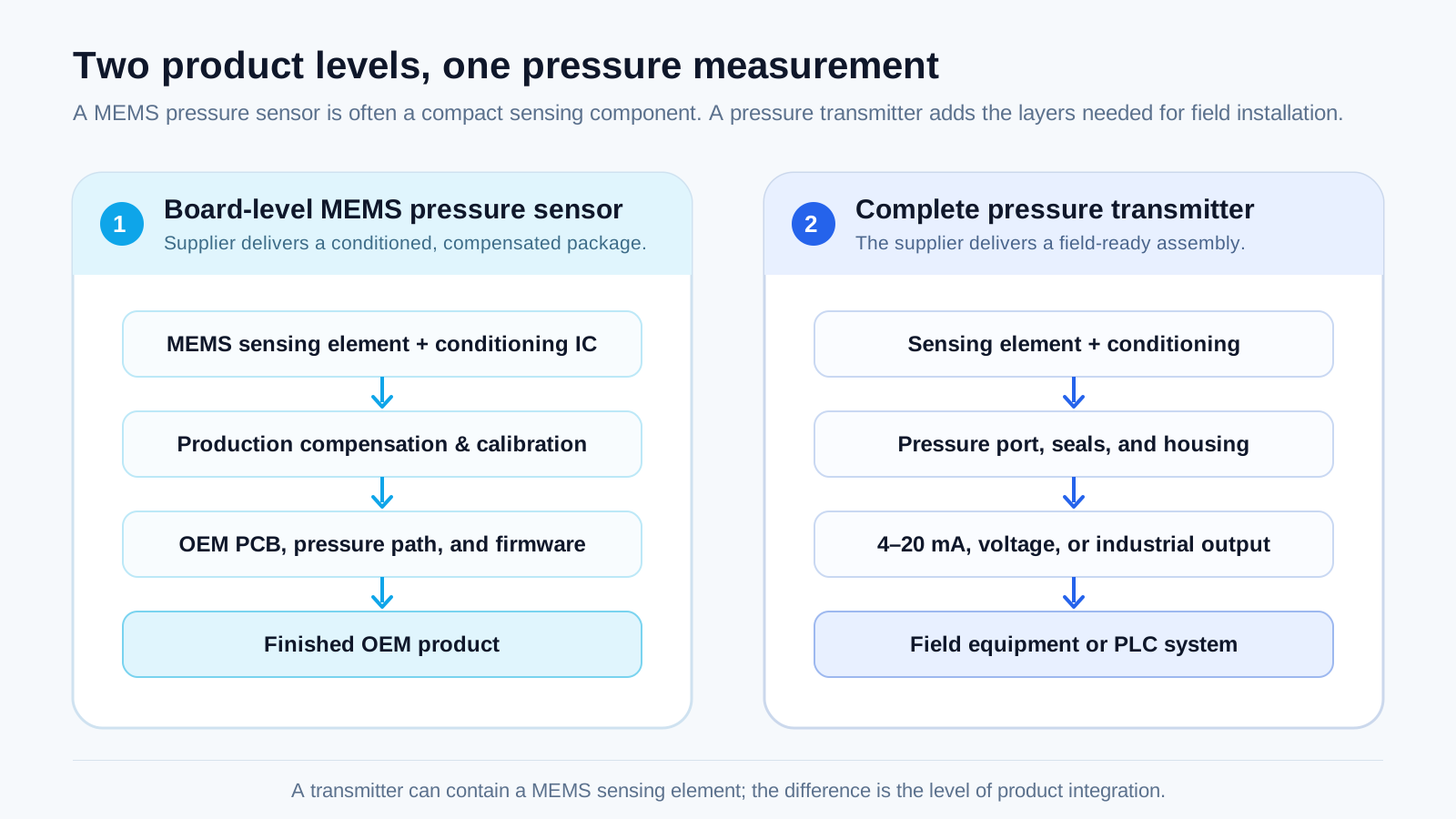
MEMS pressure sensor and pressure transmitter are different product levels, not always competing sensing technologies. A transmitter can contain a MEMS sensing element inside its signal-conditioning and mechanical assembly.
What Is the Difference?
A MEMS pressure sensor can be a sensing element, a compact sensor package, or a fully compensated board-level product. Reliava's MEMS pressure sensor products are compensated, include an internal signal-conditioning IC, and are calibrated during production. The delivered output is intended for direct OEM host integration, while the OEM still validates system-level effects such as mounting stress, pressure-path behavior, temperature, firmware conversion, and any application baseline.
A pressure transmitter is a complete measurement device. It normally combines a compensated and calibrated pressure-sensing element with signal conditioning, a pressure port, an electrical connector, a housing, and an output designed for a control or instrumentation system. Industrial transmitters often provide a current or voltage loop that can travel over field wiring.
The practical question is therefore not simply which technology is better. It is which level of integration matches the responsibilities of your product, installation, and service teams.
MEMS Pressure Sensor vs Pressure Transmitter: Side-by-Side Comparison
Product Form and Installation
- MEMS pressure sensor: Usually installed inside the OEM product on a PCB or a small carrier. The product designer selects the tubing, pressure tap, port adapter, enclosure, and connector arrangement.
- Pressure transmitter: Usually mounted directly to a pipe, manifold, vessel, or equipment port. The transmitter supplier defines the housing, pressure connection, connector, and environmental protection as a tested assembly.
Output and Electronics
- MEMS pressure sensor: Often provides a digital I²C, analog voltage, or another board-level output, depending on the model. The sensor supplier handles sensor-level conditioning, compensation, and production calibration; the host product supplies power, reads the signal, applies any system-level filtering, and decides how the measurement is displayed or controlled.
- Pressure transmitter: Often provides 4–20 mA, 0–10 V, or another controller-ready signal. The transmitter takes care of much of the excitation, conditioning, scaling, and electrical protection before the signal reaches the control system.
Media Compatibility and Pressure Path
- MEMS pressure sensor: The OEM must validate the pressure path, tubing, adhesive, filter, condensation behavior, and material compatibility in the final assembly. A sensor rated for air is not automatically suitable for liquid, corrosive gas, or contaminated media.
- Pressure transmitter: The supplier normally specifies wetted materials, port geometry, seal options, and media limitations for the complete device. The installation still has to follow the product specification and process safety requirements.
Accuracy, Calibration, and System Error
- MEMS pressure sensor: The datasheet may provide offset, span, non-linearity, hysteresis, repeatability, temperature error, or total error after sensor-level compensation and production calibration. PCB stress, tubing, airflow, supply noise, firmware conversion, and the product's system-level validation can add error beyond the component specification.
- Pressure transmitter: The published accuracy normally describes the complete transmitter under specified reference and environmental conditions. Installation position, impulse lines, vibration, temperature, and process conditions can still affect the installed measurement.
Environmental Protection and Maintenance
- MEMS pressure sensor: The product designer owns enclosure sealing, EMC protection, strain relief, service access, and replacement strategy. This gives flexibility but also creates more validation work.
- Pressure transmitter: The enclosure and connector are selected for field conditions such as vibration, moisture, dust, and temperature. If the transmitter fails, technicians can normally replace the complete device without opening the main controller.
Cost, Volume, and Customization
- MEMS pressure sensor: Usually offers the best economics and footprint when the design is produced in volume and the OEM can absorb host integration and qualification work. The supplier's sensor-level compensation and production calibration remain part of the delivered device, while package, port, range, output, and application-level options can be tailored to the platform.
- Pressure transmitter: Usually costs more per measurement point because it includes the field-ready mechanical and electrical assembly. That premium can be worthwhile when installation time, serviceability, qualification, and controller compatibility matter more than minimum component cost.
Choose a MEMS Pressure Sensor When...
- The pressure measurement is part of an OEM product. The supplier delivers a compensated and production-calibrated sensor package; you control the PCB, firmware, enclosure, pressure path, and system-level validation.
- You need a compact board-level design. A small package and a digital or analog board interface fit better than a threaded field instrument.
- You are building at medium or high volume. The engineering investment in integration and validation can be spread across many units.
- Your controller already supports the sensor interface. A supported digital or analog input is available and the firmware team can manage sampling, filtering, diagnostics, and any application-level calibration or baseline.
- The pressure path is controlled by your design. You can specify tubing, filters, materials, condensation protection, and the mechanical stress seen by the package.
Choose a Pressure Transmitter When...
- The device is installed in the field. A technician needs a defined pressure port, connector, enclosure, and mounting method rather than a component-level interface.
- The controller expects a standard industrial signal. 4–20 mA or a controller-ready voltage simplifies wiring, distance, troubleshooting, and replacement.
- You need a qualified mechanical assembly. The pressure connection, seals, housing, connector, and environmental protection should arrive as one validated device.
- Maintenance is performed at the equipment level. The service team should be able to replace and recommission a pressure instrument without redesigning the control board.
- Low integration effort is more important than minimum unit cost. A complete transmitter can reduce the amount of electrical, mechanical, and environmental qualification your team must own.
A Transmitter Can Still Use MEMS Technology
The comparison becomes clearer when the product is viewed as a stack. In a compensated MEMS sensor, the sensing element, signal-conditioning IC, compensation, and production calibration are delivered as one board-level sensor package. A transmitter adds the pressure port, seals, housing, connector, and field-ready output needed for equipment installation.
Some transmitters use MEMS sensing elements because MEMS technology can provide a compact, repeatable pressure measurement. The transmitter adds the mechanical, electrical, and application-level integration needed for field use. The key distinction is not uncalibrated versus calibrated; both product types can be compensated and calibrated. It is the level of integration delivered by the supplier and owned by the OEM.
Do not select a transmitter only because it sounds more accurate, or a MEMS sensor only because it sounds smaller. Compare the complete measurement chain and the acceptance test for the finished product.
Six Questions to Ask Before Choosing
- Where will the pressure measurement be installed? Inside a sealed OEM product, on a PCB, in a cabinet, or directly on a pipe or vessel?
- Who owns the pressure interface? Decide who validates the port, tubing, seals, filters, condensation behavior, and media compatibility.
- What signal does the receiving system need? Check I²C, SPI, analog voltage, 4–20 mA, 0–10 V, supply limits, cable length, and diagnostics.
- What pressure range and reference are required? Specify gauge, absolute, or differential pressure, the normal operating window, overload, burst requirements, and common-mode pressure where applicable.
- What accuracy must the installed system achieve? Convert percentage specifications into pressure units and account for temperature, repeatability, hysteresis, drift, noise, calibration, and assembly effects.
- How will the product be qualified and serviced? Consider EMC, vibration, temperature, ingress protection, traceability, field replacement, expected volume, lead time, and end-of-life planning.
How This Decision Maps to Reliava Products
Reliava's catalog separates board-level MEMS devices from complete pressure products. For an OEM design, review the MEMS pressure sensor family and compare the pressure reference, range, output, package, and environmental requirements of each candidate.
- Low-pressure differential OEM designs: the RP3112D differential MEMS pressure sensor is a useful example of a compact sensor family for board-level integration. Confirm the selected range, interface, pressure path, and application conditions in the current datasheet.
- Gauge or absolute pressure designs: use the product catalog to compare reference type, package, output, and range before choosing among the MEMS families.
- Field and PLC-connected installations: a complete device such as the RT4013 gauge pressure transmitter is the type of product to evaluate when a threaded pressure connection and 4–20 mA signal are part of the requirement.
If the application is still at the architecture stage, start with the general pressure sensor selection guide. It covers the broader selection factors; this comparison focuses on choosing the right product level.
Common Selection Mistakes
- Treating MEMS and transmitter as mutually exclusive technologies: a transmitter may use a MEMS sensing element, so compare the complete assembly and interface instead of the label alone.
- Comparing only the headline accuracy: check the definition, reference conditions, total error, temperature range, pressure medium, and installed system error.
- Ignoring the pressure path: tubing, filters, dead volume, condensation, leaks, port orientation, and common-mode pressure can dominate a low-pressure measurement.
- Choosing an industrial output too early: 4–20 mA is valuable for field wiring, but it adds electronics, power, cost, and space that an embedded OEM product may not need.
- Assuming board-level means unconditioned or uncalibrated: Confirm whether the sensor includes a signal-conditioning IC and production compensation/calibration. Your team still needs to validate PCB layout, pressure-path behavior, EMC, enclosure sealing, connector design, and system-level production test.
Frequently Asked Questions
Is a MEMS pressure sensor better than a pressure transmitter?
Neither is universally better. A MEMS pressure sensor is often the better fit for a compact, high-volume OEM product. A pressure transmitter is often the better fit for a field installation that needs a protected housing, defined pressure connection, and standard control-system output.
Are Reliava MEMS pressure sensors already compensated and calibrated?
Yes. Reliava's MEMS pressure sensor products are compensated, integrate a signal-conditioning IC, and are calibrated during production. The OEM does not start with an unconditioned sensing element; it integrates the specified sensor output into the host product and validates system-level effects such as mounting, pressure tubing, temperature, firmware, and application baselines.
Does choosing a MEMS pressure sensor mean we must calibrate it from scratch?
No. Sensor-level compensation and production calibration are completed by the supplier. An OEM may still perform a system-level check or application calibration to account for the assembled pressure path, PCB stress, enclosure, installation, and the final product's operating conditions.
Can a MEMS pressure sensor connect directly to a PLC?
Usually, no. Most board-level MEMS pressure sensors send I²C, SPI, or a low-voltage analog signal. A PLC usually expects 4–20 mA, 0–10 V, or a specific industrial communication protocol. If the sensor and PLC use different signal types, you need an interface module or a pressure transmitter between them to convert the signal. For a direct PLC connection, choose a pressure transmitter with a PLC-compatible output, such as 4–20 mA. Sensor-level compensation and production calibration may already be completed by the supplier, but the finished system should still be checked after installation.
Are pressure transmitters always more accurate?
No. Accuracy depends on the sensing element, calibration, compensation, pressure range, temperature, installation, and error definition. A transmitter may present a more complete and documented installed product, but a well-integrated MEMS sensor can meet demanding OEM requirements when the entire measurement chain is validated.
Can a pressure transmitter contain a MEMS sensor?
Yes. MEMS describes one sensing technology, while transmitter describes a complete device and output architecture. The two terms can describe different layers of the same pressure-measurement system.
When is a pressure transmitter over-specified?
A transmitter may be more than you need when the sensor will be mounted inside an OEM product, the controller already has a digital or analog input, the pressure path is clean and controlled, and the production volume justifies your own integration and validation. In that case, a board-level MEMS sensor can reduce size and unit cost.
What information should I send a supplier?
Provide the pressure reference and range, normal and maximum pressure, medium, temperature, common-mode pressure, output interface, supply, accuracy or smallest detectable change, pressure port, installation constraints, qualification requirements, annual volume, and target launch date. This lets the supplier recommend the product level as well as the sensor range.
Conclusion
The choice between a MEMS pressure sensor and a pressure transmitter is mainly an integration decision. Select a compensated MEMS route when you need a production-calibrated board-level device and your OEM product owns the host electronics, pressure path, and system validation. Select the transmitter route when the installation needs a complete, protected, controller-ready field instrument.
Define the measurement chain first, then compare range, pressure reference, output, media, accuracy, temperature, environmental protection, volume, and service requirements. For a product recommendation, send Reliava those requirements together with your expected volume and installation drawing.